
Dream of the Red Chamber – An Abridged English Retelling
An unused stone longs to experience the human world. In Suzhou, a quiet scholar has a strange dream that hints at the lives soon to unfold around him. This opening introduces the enchanted jade, the promise of a debt repaid in tears, and the fragile fortunes of two families.
About This Retelling
This abridged English retelling draws on the public-domain Chinese classic Dream of the Red Chamber, also known as The Story of the Stone, by Cao Xueqin. It presents the main events in accessible modern English, with selected passages summarized. The chapter numbering follows HDNovel’s existing reading sequence; this installment includes events extending beyond the original novel’s first chapter.
The Stone Left Behind
Long ago, when the goddess Nüwa repaired the broken sky, she prepared thousands of stones for the task. One remained unused beneath Qinggeng Peak in the Great Wilderness Mountains.
Touched by divine power, the stone had become aware of itself. Yet that awareness brought no peace. While the other stones had helped restore the heavens, it had been left behind. It brooded over its uselessness and yearned for another kind of life.
One day, a Buddhist monk and a Daoist priest passed the mountain. They spoke of the pleasures and troubles of the human world. The stone listened eagerly and begged them to take it along.
They warned it that earthly happiness never lasts. Wealth fades, affection brings sorrow, and every gathering ends in separation. Still, the stone wanted to see that world for itself.
The monk transformed it into a small, luminous piece of jade that could be carried in the hand. He would mark it so that people recognized its unusual nature, then take it into a prosperous household.
“Where will I go?” the stone asked.
“You will learn when the time comes,” the monk replied.
He slipped the jade into his sleeve, and the two travelers departed.
A Story Written on Stone
Much later, a Daoist known as Kongkong came upon a stone covered with writing. Its inscription told of a journey through the human world: the people the stone had encountered, the happiness they had pursued, and the grief that followed.
The account named no dynasty. Its interest lay in ordinary lives, especially the women whose experiences had left such a deep impression on the storyteller.
Kongkong read it, questioned it, and finally copied it. In the novel’s framing story, the manuscript passes through different hands and acquires different titles. Cao Xueqin is described as spending years revising it into the work presented to the reader.
Beneath this playful account of authorship lies a serious question: who can understand the sorrow hidden inside a seemingly fantastic tale?
The story now turns to Suzhou.
Zhen Shiyin’s Dream
Near the Gourd Temple lived Zhen Shiyin and his wife, Lady Feng. They were comfortable, though not exceptionally wealthy. Shiyin had little appetite for public office. He preferred books, flowers, bamboo, and the quiet pleasures of home.
Their greatest joy was their young daughter, Yinglian.
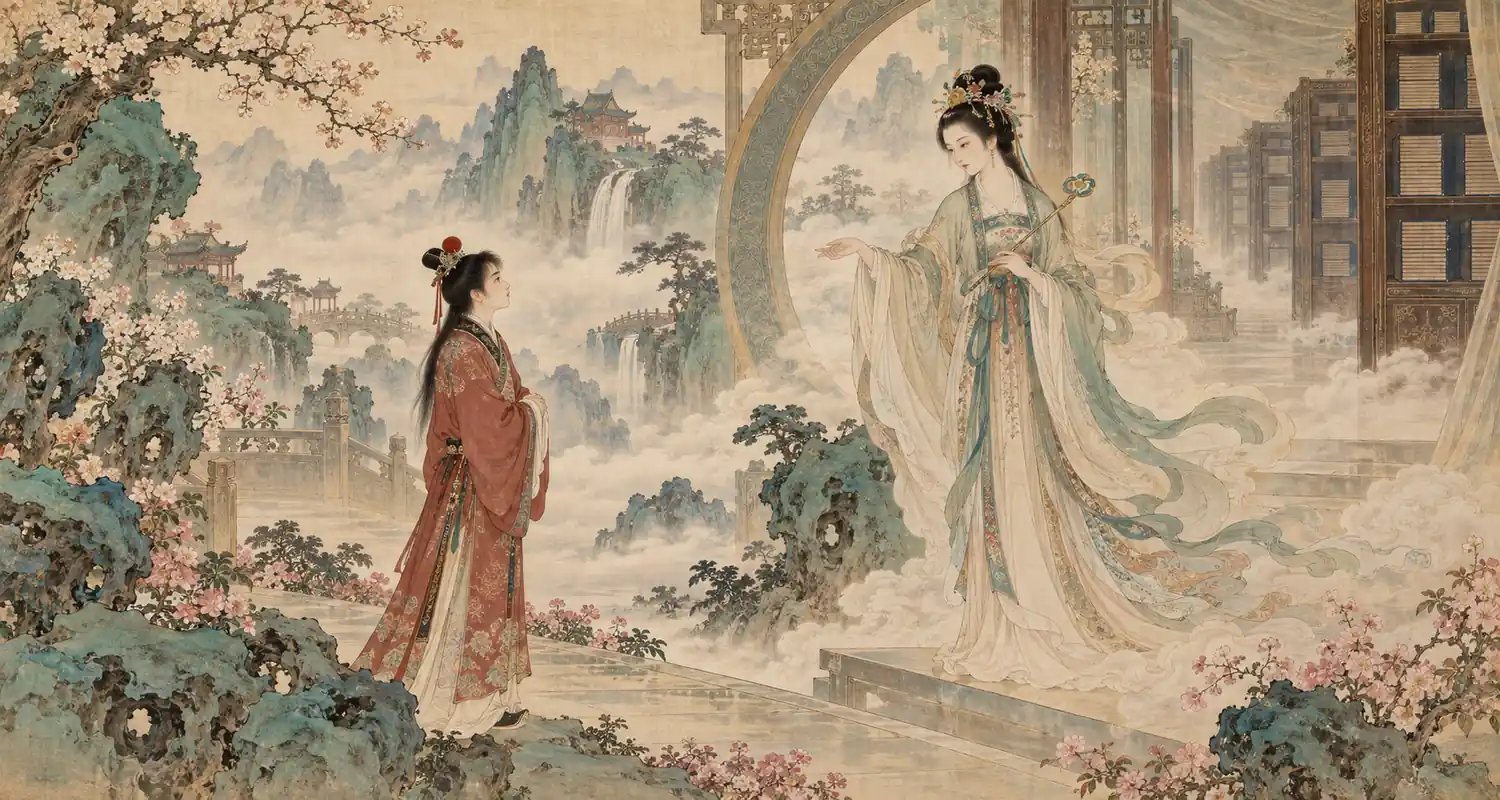
One hot afternoon, Shiyin grew drowsy over a book. In his dream, he found himself near a monk and a Daoist priest. They were discussing a group of souls preparing to enter the human world, where old ties of affection would be worked out through new lives.
The monk told of a plant called Crimson Pearl, growing beside the River of Spirits. A divine attendant, Shenying, had watered it with celestial dew. Sustained by his care, the plant had taken human form.
When Shenying chose to descend into the mortal world, Crimson Pearl wished to follow. She had no dew to return to him, she said, but she could repay his kindness with the tears of her earthly life.
Other souls would join them, drawn by relationships that had yet to reach their end. The monk and priest also planned to bring the transformed stone into this unfolding story.
Shiyin approached and asked what their words meant. They declined to explain the secrets of the journey, but the monk let him examine the jade.
On its face were words identifying it as a precious jade with spiritual power. Before Shiyin could study the smaller inscription on the back, the monk took it away.
The travelers approached an archway leading into the Land of Illusion. Its inscription unsettled the boundary between truth and falsehood, existence and emptiness.
Shiyin tried to follow. A crashing sound shook the dream, and he woke.
A Warning at the Door
His daughter was brought to him, and he carried her outside. Two ragged travelers appeared in the street: a monk and a Daoist priest.
At the sight of Yinglian, the monk began to weep. He urged Shiyin to let the child go with him. Shiyin, alarmed and irritated, turned back toward the house.
The monk spoke a warning about the Lantern Festival and a disaster involving fire. Before Shiyin could question him, the pair had disappeared.
Another visitor soon approached. Jia Yucun, an impoverished scholar lodging at the nearby temple, supported himself by selling his writing. His family had declined, but he still hoped to travel to the capital and succeed in the imperial examinations.
Shiyin welcomed him into his study. When another guest arrived, Shiyin briefly left him alone.
During this visit, Yucun noticed a maid named Jiao Xing. She glanced at him more than once. He took those glances as a sign that she recognized something in him beyond his poverty. The small encounter stayed in his mind.
A Gift and a Departure
At the Mid-Autumn Festival, Yucun felt the weight of his situation. Far from home and short of money, he could see no clear path toward the career he desired.
Shiyin invited him to share a meal and wine. As the evening went on, Yucun admitted that the cost of travel was keeping him from the examinations.
Shiyin offered him fifty taels of silver and winter clothing. He urged him to make the journey while the opportunity was open.
Yucun thanked him, but he did not wait for a formal farewell. By the time Shiyin sent for him the next morning, he had already left. The monk at the temple passed along his thanks.
For one man, a door had opened. For the other, misfortune was approaching.
Yinglian Disappears
At the Lantern Festival, a servant named Huo Qi took Yinglian out to see the lights. He left her briefly on a doorstep while he went to relieve himself. When he returned, she was gone.
He searched in terror, then fled rather than face her parents.
Shiyin and Lady Feng sent people to look for their daughter, but no trace of her could be found. Grief broke their health.
Later, a fire began in the Gourd Temple and spread through the surrounding neighborhood. The Zhen family escaped with their lives, but their house was destroyed.
They withdrew to the countryside. Trouble followed them there: hardship and disorder made the property difficult to keep. Shiyin sold what he could and took his wife to her father, Feng Su.
Feng Su accepted their money and promised to arrange a new home. Instead, he kept much of it for himself and bought poor property for his son-in-law. Shiyin had neither the experience nor the strength to make a living from the land.
As the family’s circumstances worsened, Feng Su blamed him. Illness, humiliation, and the loss of Yinglian wore him down.
What Remains When Everything Passes
One day, Shiyin encountered a limping Daoist priest singing about the things people cannot bear to surrender: rank, money, marriage, and children.
The song asked what any of these could promise against death and change. Famous men vanished; wealth outlived its owners; love and family could not hold a life in place forever.
Shiyin stopped him and asked about the repeated words in the refrain. The priest explained the connection between being done with worldly attachments and finding release.
Shiyin understood the song through his own experience. He answered with images of reversal: grand houses falling empty, riches turning to poverty, youth giving way to age, and one family taking the place of another on the same stage.
The priest applauded his understanding.
Shiyin decided to follow him. He left without returning home.
Lady Feng searched for her husband, but no news came. She remained with her father, carrying the losses of both husband and child.
Jia Yucun Returns
Meanwhile, Yucun’s journey had succeeded. He passed the examinations and obtained an official appointment.
When his procession later passed the household where Lady Feng was living, Jiao Xing saw him and thought his face familiar. That evening, officials came asking for Zhen Shiyin.
Feng Su explained that his son-in-law had disappeared. At the magistrate’s residence, he learned that the official was Jia Yucun, the scholar whom Shiyin had once helped.
Yucun was saddened by the account of the family’s losses. He sent assistance to Lady Feng and promised to help search for Yinglian.
He also asked for Jiao Xing, whose brief glances he had remembered, to join his household as a concubine. Feng Su eagerly helped arrange it. An apparently minor encounter had changed the course of her life.
Yucun’s own good fortune did not last. Talented but arrogant, he alienated his superiors and was dismissed from office.
After making arrangements for his family, he traveled. In Yangzhou, illness and dwindling funds left him in need of work. Friends recommended him as a tutor to the household of Lin Ruhai.
Lin Daiyu and Her Family
Lin Ruhai came from a distinguished family and held an appointment supervising the salt administration. His wife, Jia Min, belonged to the Jia family.
Their young daughter, Lin Daiyu, was delicate in health and deeply loved. Her father arranged for her to study under Yucun, though her lessons were adjusted to what she could manage.
Then Jia Min fell ill and died. Daiyu’s grief further weakened her, and her education was interrupted.
With time on his hands, Yucun wandered outside the city. He came across a neglected temple whose inscription warned of the difficulty of turning back after pursuing worldly gain too far.
At a nearby inn, he met Leng Zixing, an antiques dealer he knew from the capital. Over food and wine, their conversation turned to the Jia family.
The Two Jia Houses
Leng Zixing described two branches of a once-powerful family: the Ningguo and Rongguo houses. Their grandeur remained visible, but he believed their strength was declining beneath the surface.
In the Ningguo branch, Jia Jing had withdrawn from family affairs to pursue religious practices. His son Jia Zhen managed the household, where pleasure often took precedence over responsibility. Jia Zhen’s son was Jia Rong.
In the Rongguo branch, the older generation’s legacy continued under the family matriarch, Grandmother Jia. Her sons were Jia She and Jia Zheng. Jia Zheng took study and official duty seriously, but his household held an extraordinary child.
His son Jia Baoyu had been born with a piece of jade in his mouth.
Yucun listened closely. The unusual birth seemed to suggest that the boy’s life would not be ordinary.
Leng Zixing described Baoyu as clever and spirited, but troubling to his father. As a small child, he had preferred women’s ornaments to the objects expected to predict a scholarly career. He also spoke of girls with unusual affection and of men with distaste.
Leng Zixing treated these habits as signs of a spoiled boy. Yucun resisted that easy judgment. Some people, he argued, possessed unusual qualities that could not be measured by ordinary expectations. Family circumstances and education would help shape what became of them.
The conversation moved to the girls of the Jia family: Yuanchun, who had entered palace service; Yingchun; Tanchun; and Xichun. Their names shared the character for spring.
Jia Min, Daiyu’s late mother, was also part of this family. Through her, Daiyu was connected to the great household now coming into view.
Leng Zixing also described Jia Lian and his wife, Wang Xifeng. She was beautiful, eloquent, and exceptionally capable. In his account, her intelligence and force of character made her someone whose influence could not be ignored.
The story has moved from an abandoned stone to a family of wealth and rank. Yet Shiyin’s losses remain a warning in the background: a prosperous house is no guarantee that happiness will endure.
Chapter Summary
An unused stone enters the human world as enchanted jade. Zhen Shiyin dreams of souls whose earthly lives will carry old emotional debts, then loses his daughter and home before following a Daoist priest. Jia Yucun rises through the examinations, loses his post, and becomes Lin Daiyu’s tutor. A conversation with Leng Zixing introduces the Jia family and the extraordinary birth of Jia Baoyu.
Character Notes
| Character | Who they are in this installment |
|---|---|
| Zhen Shiyin | A scholar whose dream and losses introduce the novel’s themes. |
| Yinglian | Shiyin and Lady Feng’s young daughter, who disappears at the Lantern Festival. |
| Jia Yucun | An ambitious scholar helped by Shiyin; later an official and Daiyu’s tutor. |
| Jiao Xing | A maid whose brief encounter with Yucun changes her circumstances. |
| Lin Daiyu | Lin Ruhai and Jia Min’s daughter, connected to the Jia household through her mother. |
| Jia Baoyu | A boy born with jade in his mouth, much loved by his grandmother. |
| Leng Zixing | An antiques dealer who introduces the two Jia households. |
| Wang Xifeng | Jia Lian’s capable and influential wife. |
Cultural Notes
Nüwa: A goddess associated with repairing the sky in Chinese mythology. The unused stone connects this familiar myth with the novel’s fictional world.
The imperial examinations: A path into government service through literary study and examinations. Yucun’s ambitions depend on success within this system.
The festivals: The Mid-Autumn Festival emphasizes reunion, while the Lantern Festival brings public celebrations and lantern displays. Their festive setting sharpens the contrast with loneliness and loss.
Truth and illusion: The dream, the jade, and the Land of Illusion introduce a recurring question: how reliably can appearances reveal the meaning of a life?